

Dear Baba,
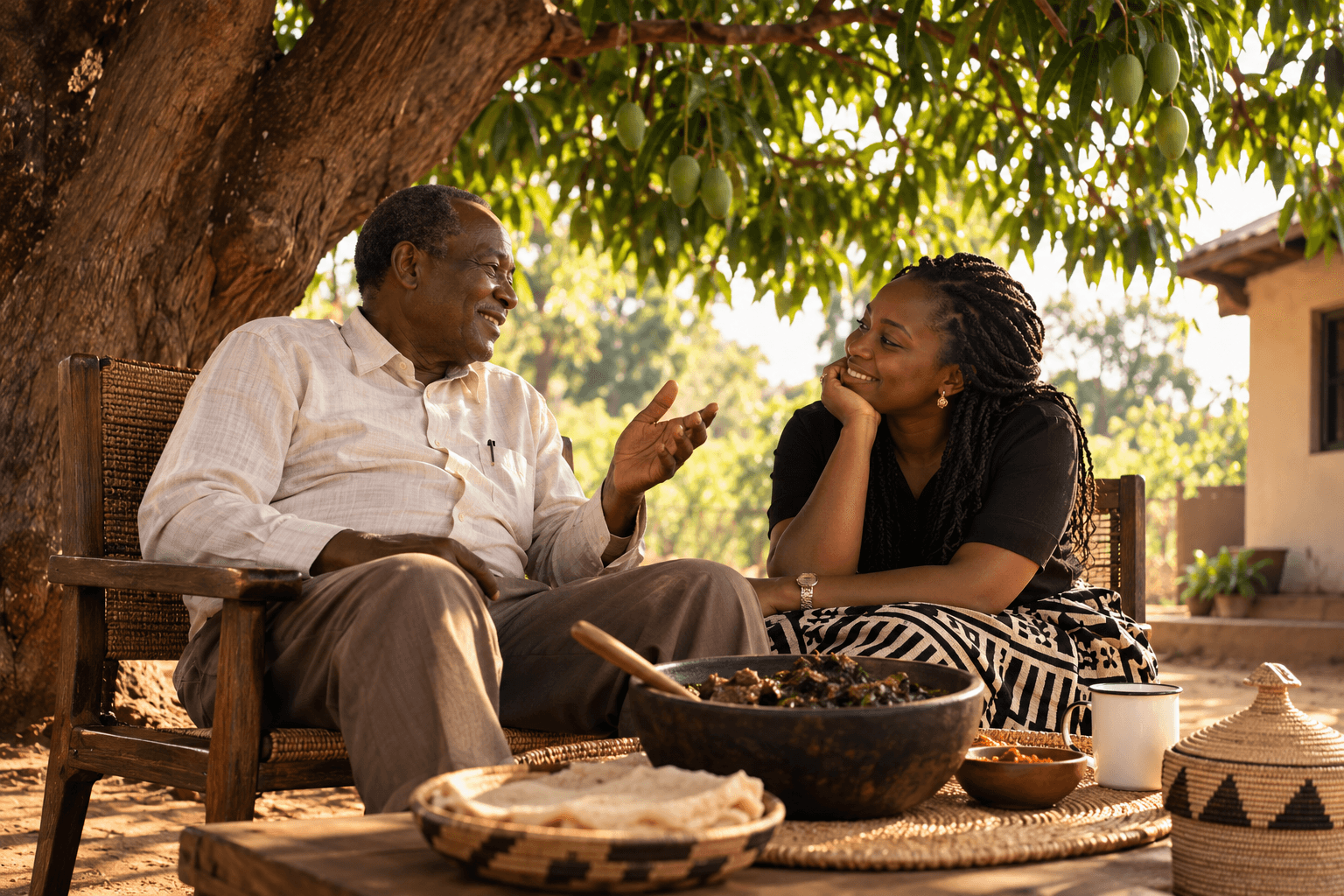
If you were here, I think we would be sitting under the mango tree.
Sunday afternoon.
Church finished. Good clothes changed. The house settling into that lazy Sunday quiet where nobody is in a hurry because Monday has not yet announced itself.
There would be a plate of awalwala somewhere between us.
Mine, obviously.
And before you ask, no.
I still don't know how to make it.
I could cook then, Baba. I can cook now. We both know cooking was never the problem.
It was kisra and awalwala. Those two simply refused to become part of my skill set.
Of all the things you kept telling us girls to learn, those two somehow escaped the curriculum.
In my defence, I had a plan.
Remember how I used to say I would marry a white man?
I genuinely believed this was a sound culinary strategy. Why master kisra and awalwala when my future husband would probably be perfectly happy with potatoes?
You tried to warn us.
You kept telling us to make more South Sudanese food. Kisra. Awalwala. The foods of home. You worried that growing up in Kenya was making us too Kenyanised.
You were probably right.
But life, as usual, had jokes.
Let's just say the white man plan did not age particularly well.
I somehow found myself with possibly the Africanest man God had available.
Thankfully, the Lord remembered that I cannot make kisra and gave the man an appreciation for chapati and chips.
Providence.
Anyway, Baba.
You have missed so much.
I don't even know where to begin.
Maybe that's why I've started writing to you.
There are things I have wanted to tell you for nine years. Big things. Small things. Things that would have made you smile. Things that would have started one of our debates about life, where you would calmly make your point and I would calmly make mine, both of us pretending the other person was eventually going to concede.
You were always so calm.
So soft.
Even when we disagreed, it never felt like fighting.
I miss that.
I miss having access to your mind.
But before I give you the life update, there is something I need to tell you.
I'm still angry with you.
You lied to me.
You said you were just going to get checked.
That's all.
You were going to the hospital to get checked.
And then you didn't come back.
Baba, what kind of arrangement was that?
There should have been a disclaimer.
Terms and conditions.
A return policy.
Something.
You cannot tell your daughter you're just going to get checked and then disappear for nine years.
I still replay our last conversation.
I can see you.
I can hear you.
I can see myself there too, completely unaware that I was standing inside a last time.
Sometimes I go back looking for clues.
Did you know?
Was there something I missed?
Was there something I should have asked?
Something I should have said?
Should I have stayed a little longer?
There is a particular cruelty in an ordinary last conversation.
Nobody announces it.
Nobody says:
Pay attention. This is the last time.
So you speak normally.
You leave things unsaid because you assume there will be another conversation.
Another Sunday.
Another debate.
Another meal.
Another afternoon under the mango tree.
And then there isn't.
Still, I am grateful.
Because whatever grief has taken from me, it cannot take away the fact that the last time I spoke to my father, I was there.
I saw you.
I heard you.
I just didn't know I was saying goodbye.
Four months earlier, there had been another conversation.
My graduation day.
Nairobi was cold that morning. That irritating Nairobi cold that has absolutely no respect for graduation gowns or important life moments.
And somewhere between the photographs, congratulations and excitement about what came next, you told me something I didn't understand.
You said I was your hope.
Your hope.
Baba, I didn't know what to do with that.
Hope for what?
Why me?
What exactly was I supposed to do with this hope you had casually placed in my hands?
I wish I had asked you.
But perhaps daughters always think there will be time to ask their fathers what they meant.
Nine years later, I think I understand.
Or at least I have my version.
Maybe you weren't asking me to become extraordinary.
Maybe you were asking me to remember who I was.
And whose daughter I was.
You taught us unity.
Passion.
Integrity.
Family.
At the time, they were simply Baba's lessons.
Now I find myself returning to them.
When I have to make a difficult decision.
When doing the right thing would be easier to avoid.
When work demands more of me.
When family becomes complicated.
Especially when family becomes complicated.
I choose family, Baba.
Again and again.
Sometimes when it is inconvenient.
Sometimes when I am tired.
Sometimes when I would very much like to switch off my phone and let everybody solve their own problems.
And then somewhere in my head, there you are.
Unity.
Family.
Integrity.
Very clever, Baba.
You managed to continue parenting from beyond the grave.
I work hard too.
And smart.
I think you would recognise that part of me.
I care deeply about the things I put my name to. I want my work to mean something. I don't like doing things halfway.
Sometimes I catch myself approaching something a certain way and think:
Oh.
There you are.
A principle.
A stubborn streak disguised as commitment.
A way of working.
A way of choosing people.
A way of choosing family.
Pieces of you that somehow became pieces of me.
I won't lie to you and make grief sound beautiful.
It isn't.
Losing you scarred me.
I think it always will.
There is the person I was before you died and the person who had to learn how to live after.
We used to be seven.
Mummy. You. Five children.
Seven.
Then suddenly we became #7minus1.
I made that hashtag because I think I needed somewhere to put the mathematics of losing you.
Seven minus one equals six.
Simple.
Except grief has never respected mathematics.
How can one person leave and the absence feel larger than one?
How can a chair hold an entire person simply by being empty?
How can a family still be whole and still have a hole in it?
Nine years later, I still don't know.
I miss you, Baba.
Of course I miss you in the big moments.
But mostly I miss you in the ordinary ones.
I miss sitting around doing absolutely nothing important.
I miss our conversations.
Our debates.
I miss the softness with which you spoke.
Mostly, I miss knowing you were somewhere in the world.
But here is the strange thing.
Sometimes I feel you.
Not in some dramatic thunder and lightning way.
Just quietly.
A thought arriving at exactly the right moment.
A memory I wasn't looking for.
One of your lessons returning when I need it.
And sometimes, in my head, I hear you call me the way only you did.
Chum Chumaa.
I can almost hear your voice saying it.
I was named after your grandmother.
When I was younger, that was simply the explanation for my name.
Now I understand it differently.
Her name travelled through you and arrived at me. I was carrying someone from your story before I even understood what inheritance meant.
And now I carry you too.
Maybe that's why Chum Chumaa feels different now.
Achom is my name.
But Chum Chumaa is your voice.
And for a second, you are close again.
Maybe that's memory.
Maybe that's love.
Or maybe you really are there, still talking to me.
I like that possibility better.
I suppose if I had to lose my father, having a guardian angel is not the worst consolation prize.
But Baba, I would still prefer you.
Every time.
I would trade the angel for one more Sunday afternoon.
One more mango tree.
One more conversation.
One more debate about life where neither of us is technically arguing, but both of us are definitely trying to prove a point.
One more chance to ask what you meant when you called me your hope.
One more chance to hear you say:
Chum Chumaa.
There is so much more to tell you, Baba.
But not today.
We have other letters.
For now, let's stay here a little longer.
Under the mango tree.
You can ask me why, after all your warnings about becoming too Kenyanised, I still cannot make kisra or awalwala.
I will remind you that two missing dishes do not invalidate an otherwise respectable culinary record.
You will disagree.
Calmly, of course.
And I will debate the evidence.
For a little while, we can pretend we are still seven.
I miss you, Baba.
I love you.
And I'm still carrying the hope.
Nine years later, I think I finally understand.
Your
Chum Chumaa.