

Do you ever find it funny, the things people say when someone is grieving?
Not haha funny.
More like, did you really just say that to me while I'm mourning my father? funny.
I've never known what to say to someone who is grieving. I don't say, “I understand what you're going through.”
Because I don't.
How could I?
I can only imagine what you're going through.
So I would rather sit beside you. Hug you. Cry with you. Let you cry until there are no tears left for that particular hour.
Sometimes silence is the kindest condolence.
I learned this after my father died.
A few months after we buried him, the pain was still fresh. Grief hadn't packed its bags and politely left our house.
It lingered.
Worse, it became sneaky.
A perfume could summon him.
A familiar road.
A place we'd been together.
A conversation.
Even weeds.
Yes.
Weeds.
My father was a farmer.
Not the gumboots and hoe kind of farmer you might be imagining. A polished farmer. The sort with degrees long enough to require their own paragraph.
A BSc in Agriculture, specializing in Pesticide Chemistry.
A Master's in Agriculture, Applied Entomology.
A PhD in Agriculture, Applied Entomology.
Basically, if it crawled, flew, ate crops or had six legs, my father probably knew its entire family tree.
Locusts. Grasshoppers.
I still don't know the difference.
Then add their dramatic cousin, the praying mantis.
By the way, is it true that if a praying mantis appears at your door, visitors are coming?
I don't know.
What I do know is that after my father died, insects became little grief grenades.
A locust could detonate a memory.
A bee could ruin my afternoon.
I would see one and suddenly remember one of our completely random conversations. The kind you never think to treasure because you assume there will be thousands more.
Until there aren't.
That was grief.
It didn't always knock.
Sometimes it buzzed.
Then came my uncle.
A distant uncle.
And, bless him, I genuinely believe the man thought he was helping.
He approached my sisters and me with what I can only assume he considered a comforting contribution to our grief.
Before I tell you what he said, I need to explain our family.
We are seven.
Or rather, we were seven.
A mother.
A father.
Three daughters.
Two sons.
In that order.
Five children.
Simple mathematics, yes?
Wrong.
Because somewhere, in a sacred text apparently available only to the custodians of lineage, there is a scripture I must have missed:
The Dinka Bible.
Chapter 1.
Verse: Nonsense.
And according to this holy book of selective arithmetic, my father died having only...
Two children.
The sons.
The three daughters?
Apparently, we were footnotes.
Three living, breathing footnotes standing right there, grieving the same father.
But when lineage entered the room, we somehow disappeared from the scripture.
Five became two.
And Master Society, apparently, had checked the maths.
So my dear uncle looked at this grieving family, assessed the situation and decided what we really needed was...
another wife for my dead father.
Yes.
You read that correctly.
His suggestion was that the family should marry a woman in my father's name, after his death, so that she could bear more children for him and continue his lineage.
I wanted to laugh.
I really did.
But there is a particular guilt that comes with laughter when you're supposed to be grieving.
So the humor got stuck somewhere between my chest and my throat.
I remember thinking:
Am I hearing this correctly?
Why?
Whaaaayyyy?
My father had five children.
Three of us were standing right there.
Alive.
Grieving.
Existing quite visibly.
Yet somehow the emergency was that the dead man needed more children.
Not comfort for his widow.
Not comfort for his daughters.
Not even, “How are you girls coping?”
No.
Recruitment.
My father's lineage apparently had vacancies.
Before this sounds like something my uncle invented after one too many conversations under a tree, let me explain.
This isn't new.
Among the Dinka, there are longstanding customary arrangements through which a family may marry a woman in the name of a deceased male relative so that children can continue his lineage.
And before I point too many fingers, let me complicate my own story.
I am, in a way, a product of such an arrangement.
My biological grandfather married my grandmother for his uncle.
Still with me?
Good.
Because I wasn't.
I only properly understood the implications much later, around the time of my own marriage.
Suddenly, cousins I had spent my life calling cousins were...
my nephews and nieces.
Some of these "nephews and nieces" were old enough to have given birth to me.
Imagine discovering your family tree isn't a tree.
It's a bowl of spaghetti.
You pull one strand and somebody's uncle becomes somebody's father, your cousin becomes your nephew, and everyone else seems to understand except you.
Apparently there had been a family PowerPoint presentation and I missed it.
And then I met a woman whose story stretched my brain even further.
Her parents had daughters.
Only daughters.
And somewhere in the machinery of lineage, this was treated almost as though God had made an administrative error.
No son.
No male heir.
Problem.
Solution?
The family arranged a marriage for the son who did not exist, so that children could be born into that lineage.
I have no clever commentary for this one.
I tried.
Nothing came.
Just:
Why?
And perhaps that's the uncomfortable place where I find myself with tradition.
I am Dinka.
These customs are not stories about some distant people I am studying.
They are my people.
My family.
My history.
Some traditions carry us.
Some tell us who we are.
Some hold families together across generations.
Some are beautiful precisely because they survived everything that tried to erase us.
And some deserve questions.
Loving a culture does not mean putting every tradition behind glass and writing DO NOT TOUCH underneath it.
Sometimes love means touching it.
Turning it over.
Asking where it came from.
Asking whom it protects.
Asking whom it hurts.
And asking whether something that made sense to our ancestors must automatically make sense to us.
I don't have all the answers.
I'm still trying to understand the family tree.
But I know this:
When my father died, he left five children.
Not two.
Five.
Three daughters.
Two sons.
And no amount of cultural arithmetic will subtract me from my father's legacy.
As for my uncle?
Perhaps he was trying to comfort us in the only language tradition had taught him.
I can forgive that.
But next time you're comforting someone who has just buried a parent, perhaps start with a hug.
Leave the posthumous marriage proposals for another day.
Then again, maybe my uncle did give me something.
A story.
One that forced me to ask questions about my own family that I had somehow reached adulthood without knowing how to answer.
Who belongs to whom?
Who married for whom?
Whose children became whose lineage?
Why did my cousins suddenly become my nephews and nieces?
And who decided all of this in the first place?
These are the kinds of questions that disappear when the people who know the answers disappear.
The uncle who remembers who married whom.
The grandmother who knows why.
The aunt who remembers the story differently.
The elder who can explain why a custom exists, not merely that it exists.
And then one day, they are gone.
The stories go with them.
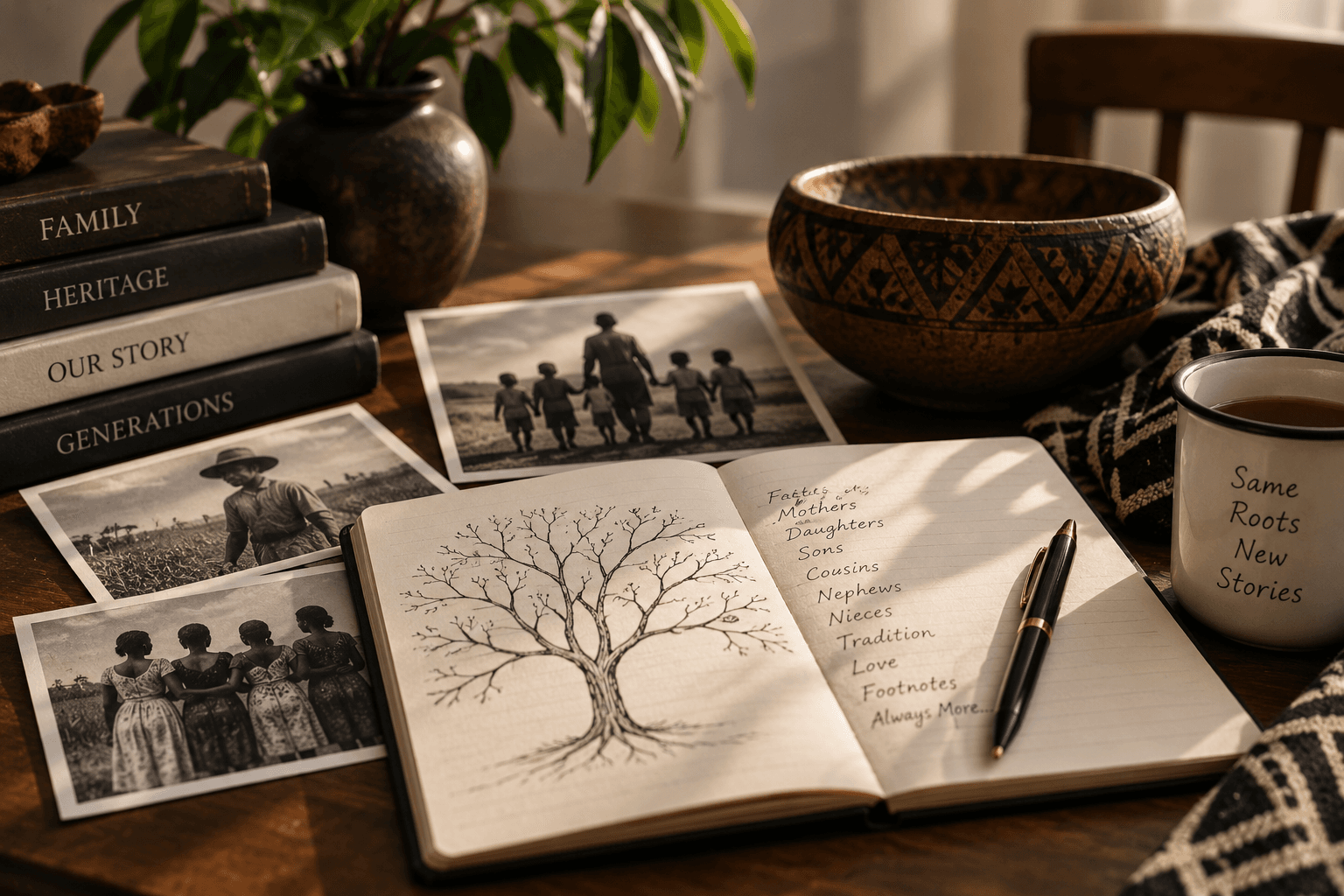
Perhaps that is why Roots feels important to me.
Roots is a digital archive developed by Savvy Gorilla Technologies, to help families preserve their histories, relationships, stories and the complicated branches that make us who we are.
And complicated they are.
If my family tree has taught me anything, it is that some trees need more than branches.
They need footnotes.
Lots of footnotes.
Because one day, someone will ask:
How exactly are we related?
And hopefully, instead of gathering seventeen uncles under a tree and receiving nineteen different answers, there will be a record.
Not to freeze culture in time.
Not to declare every tradition good simply because it is old.
And certainly not to preserve every practice unchanged simply because our ancestors practiced it.
But to remember.
Because there is a difference between preserving a tradition and preserving the story of a tradition.
We can document something and still question it.
We can understand why our ancestors did something without being obligated to repeat it.
We can love where we come from and still ask whether every road they walked is one we must continue walking.
Perhaps preservation actually makes those conversations possible.
If we know where a tradition came from, what problem it was trying to solve, whom it served and how it changed over generations, then we can make more honest decisions about what deserves to travel with us into the future.
And what deserves to remain a story about the past.
Maybe that is what Roots is really about.
Not telling the next generation what they must inherit.
Giving them enough of the story to decide for themselves.
Because traditions should be questioned.
But first, they must be remembered.